

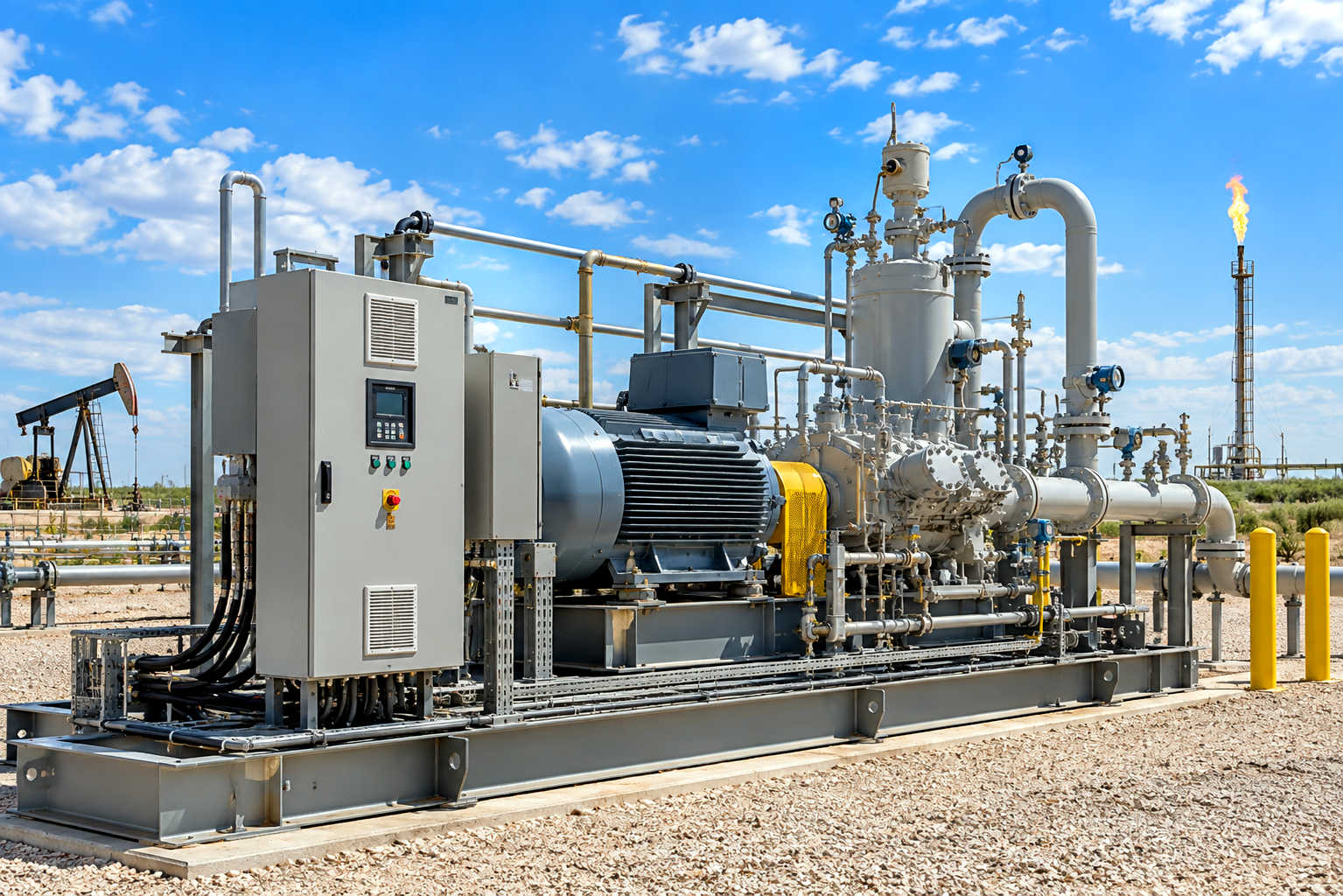
VFD Air Compressors for Changing Oil and Gas Operations
When operators search for a VFD air compressor for oil and gas service, the actual need is often an electric-drive compressor package that can respond to changing operating conditions.
For Midwest Compressor applications, the focus is natural gas compression systems designed for oil and gas operations, rather than conventional shop or plant compressed-air service., rather than conventional shop or plant compressed-air service. Pairing an electric motor with a variable frequency drive (VFD) allows compressor speed to be adjusted based on the demands of the application instead of operating continuously at one fixed motor speed.
That flexibility can be valuable at well sites, gathering systems, gas plants, vapor recovery applications, and other locations where gas volume, suction pressure, or operating requirements may change over time.
The key is selecting the right compressor, motor, VFD, controls, and package configuration for the application.
What Is a VFD Air Compressor?
A VFD air compressor uses a variable frequency drive to control the speed of the electric motor powering the compressor.
Instead of simply running the motor at full speed whenever compression is required, the VFD changes the electrical frequency supplied to the motor. This allows motor speed, and therefore compressor output, to be adjusted within the operating range of the equipment.
For natural gas compression, this can give operators greater control when gas flow or pressure conditions fluctuate.
A VFD can also provide controlled acceleration during startup rather than applying full motor speed immediately. This can reduce sudden mechanical and electrical loading while giving operators more flexibility in how the compressor responds to changing field conditions.
Why Use a VFD on an Electric-Drive Compressor?
Not every compressor application needs variable-speed control. However, an electric-drive compressor equipped with a properly selected VFD can provide several advantages when operating requirements change throughout the day, across a production cycle, or over the life of a well.
Match Compressor Output to Changing Demand
Oil and gas production rarely remains perfectly constant.
Gas volumes can increase or decline. Suction and discharge pressures can change. Gathering conditions may fluctuate. A well that requires one level of compression today may operate differently months later.
A VFD allows motor speed to be adjusted within the compressor’s approved operating range so the package can respond more closely to those changing conditions.
That can provide more flexibility than continuously operating a fixed-speed electric motor at a single speed.
Improve Energy Management at Variable Loads
One of the primary reasons operators consider a VFD for air compressor applications is the ability to reduce unnecessary motor output when full compressor capacity is not required.
The potential savings depend heavily on the application. The U.S. Department of Energy notes that variable frequency drives can improve motor speed control, process control, and system performance, although they are not the right choice for every motor-driven application.
A compressor that regularly operates under changing or partial-load conditions may benefit more from variable-speed control than a unit expected to remain near full capacity for most of its operating hours. VFDs also introduce their own electrical losses, so simply adding a drive does not guarantee lower operating costs.
The compressor package should be evaluated as a complete system before determining whether a VFD makes economic sense.
Provide Smoother Startup and Speed Control
Starting a large electric motor can place significant demand on an electrical system.
VFD control allows the motor to accelerate more gradually, providing a controlled startup rather than immediately bringing the motor to full operating speed.
Once running, operators can adjust compressor speed as conditions change, giving the system greater operating flexibility than a basic fixed-speed configuration.
Reduce Engine-Related Maintenance
Choosing an electric drive also removes many of the maintenance requirements associated with an internal-combustion engine.
There are no engine oil changes, spark plugs, fuel-system components, or other engine-specific maintenance items to manage on the compressor driver.
The electric motor, VFD, compressor, controls, cooling system, vessels, and other package components still require proper inspection and maintenance, but eliminating the gas engine can simplify some aspects of routine service.
Is a VFD Good for an Air Compressor?
A VFD can be a good choice when compressor demand varies enough to benefit from variable-speed operation.
It is not automatically the best solution for every compressor.
A site operating continuously near full load may have different economics than one experiencing substantial variations in flow or pressure. The compressor itself must also be capable of operating safely and efficiently throughout the proposed speed range.
Before specifying an air compressor VFD configuration for an oil and gas application, operators should evaluate the compressor, electric motor, available power, process conditions, required capacity, pressure range, controls, and expected operating profile as one system.
When Does a VFD Compressor Make Sense?
A VFD-controlled electric-drive compressor may be worth considering when:
- Gas volume changes substantially over time
- Suction or discharge conditions fluctuate
- The application regularly operates below maximum compressor capacity
- Electrical power is already available at the location
- Controlled motor startup is desirable
- Operators want greater control over compressor speed
- Electric drive fits the site’s operating or emissions strategy
- The compressor may need to adapt as production conditions change
The presence of electrical power alone does not determine whether a VFD is appropriate.
Horsepower requirements, voltage, available electrical capacity, gas composition, pressure conditions, liquid handling, compressor type, and the intended operating range all need to be considered.
VFD vs. Fixed-Speed Electric Drive
Both configurations can be effective for natural gas compression.
A fixed-speed electric compressor is generally simpler and may be appropriate when the application is stable and the compressor will operate near a consistent load.
A VFD drive air compressor configuration provides greater speed control and may be more attractive when operating conditions vary.
The better choice depends on how the compressor will actually be used.
For an operator, the question should not simply be, “Can we put a VFD on this compressor?”
The better question is:
Will variable-speed operation improve the performance, control, or economics of this particular application?
That answer requires looking at actual field conditions.
What Should You Know Before Selecting a VFD Compressor?
Proper compressor selection starts with information about the application.
Before recommending an electric-drive natural gas compressor and determining whether a VFD is appropriate, Midwest Compressor can evaluate factors such as:
Suction pressure: What pressure is entering the compressor?
Discharge pressure: What downstream pressure must the compressor overcome?
Gas volume: How much gas must the package handle?
Gas composition: What are the characteristics of the gas being compressed?
Available electricity: Is electrical service already present, and what power is available?
Horsepower requirements: What size electric motor and compressor are required?
Operating variability: How much are volume and pressure expected to change?
Liquid handling: Will the package need additional equipment for liquids or changing fluid conditions?
Controls and package requirements: Does the site require PLC controls, a VFD, specific vessels, bypass equipment, or an on-skid or off-skid control panel?
Midwest Compressor’s compressor packages can be configured with electric drives, and VFD drives are available depending on the application. The company also offers compressor packages for sale, lease, and rent. Midwest Compressor Systems
Rent, Lease, or Purchase an Electric-Drive Compressor
Selecting the compressor is only part of the decision.
Operators should also consider how long the equipment will be required and how certain the site’s future compression needs are.
Natural gas compressor rental or leasing can provide flexibility for changing production conditions, temporary compression requirements, testing, or applications where operators do not want to commit immediately to equipment ownership.
Purchasing may make more sense for established applications where compression requirements are well understood and the package is expected to remain in service long term.
Midwest Compressor offers natural gas compressor packages for sale, lease, and rent, allowing operators to choose an acquisition strategy that fits the application as well as the budget. Midwest Compressor Systems
Configure a VFD Compressor for Your Operation
Choosing a VFD-controlled compressor should begin with the conditions at the site, not with a one-size-fits-all equipment recommendation.
Midwest Compressor works with oil and gas operators to evaluate pressure, gas volume, power availability, compressor requirements, controls, and package options before recommending a solution.
Available natural gas compression options include electric and gas-engine-driven units, screw compressor packages, liquid ring packages, VFD controls, and additional package components based on the application. Midwest Compressor Systems
Whether you are evaluating a new electric-drive installation, replacing an existing gas-driven compressor, or determining whether variable-speed control makes sense for a changing production application, the first step is understanding what the compressor needs to accomplish.
Frequently Asked Questions About VFD Air Compressors
What is a VFD air compressor?
A VFD air compressor uses a variable frequency drive to control the speed of the electric motor powering the compressor. By adjusting motor speed, the compressor can respond more closely to changing operating conditions instead of running at one fixed speed.
For oil and gas applications, VFD-controlled electric-drive compressors can help operators manage changing gas volumes, pressure requirements, and production conditions.
Is a VFD good for an air compressor?
A VFD can be a good fit when compressor demand varies and the equipment can operate safely across a range of speeds. Variable-speed control may improve operating flexibility and help reduce unnecessary power use when full compressor capacity is not required.
However, a VFD is not automatically the best choice for every compressor application. The compressor, motor, available power, pressure requirements, gas volume, and expected operating range should all be evaluated before selecting a VFD system.
What are the benefits of using a VFD on an air compressor?
Using a VFD on an air compressor can provide several advantages, including adjustable compressor speed, smoother motor startup, better response to changing operating conditions, and improved control at partial loads.
In oil and gas compression applications, these benefits can be especially useful when gas volume or pressure changes over time.
Can a VFD be used with a natural gas compressor?
Yes. A VFD can be used with an electric-drive natural gas compressor when the compressor, motor, electrical system, and controls are properly matched to the application.
The correct configuration depends on factors such as horsepower, voltage, suction pressure, discharge pressure, gas volume, and the operating range of the compressor.
What information is needed to select a VFD air compressor?
Selecting a VFD air compressor should start with the operating conditions at the site. Important factors include suction pressure, discharge pressure, gas volume, gas composition, available electrical service, horsepower requirements, expected operating variability, and any control or package requirements.
This information helps determine whether a VFD is appropriate and what compressor package configuration will best fit the application.
Is a VFD compressor better than a fixed-speed compressor?
Not necessarily. A VFD compressor may be a better option when demand changes frequently or when greater speed control is needed. A fixed-speed compressor can still be a good choice for stable applications that operate near a consistent load.
The better option depends on how the compressor will actually be used and the operating conditions at the site.
Can Midwest Compressor provide VFD-controlled compressor packages?
Midwest Compressor can provide electric-drive natural gas compressor packages with VFD controls based on the requirements of the application. Packages can be configured around operating conditions, available power, compressor type, controls, and other site-specific needs.
Operators can also evaluate rental, lease, or purchase options depending on the expected duration and needs of the project.
Find the Right Electric-Drive Compressor for Your Site
Need an electric-drive natural gas compressor with VFD control?
Tell Midwest Compressor about your suction pressure, discharge pressure, gas volume, available electricity, and operating goals. The team can help determine the compressor package and control configuration that fits your application.