

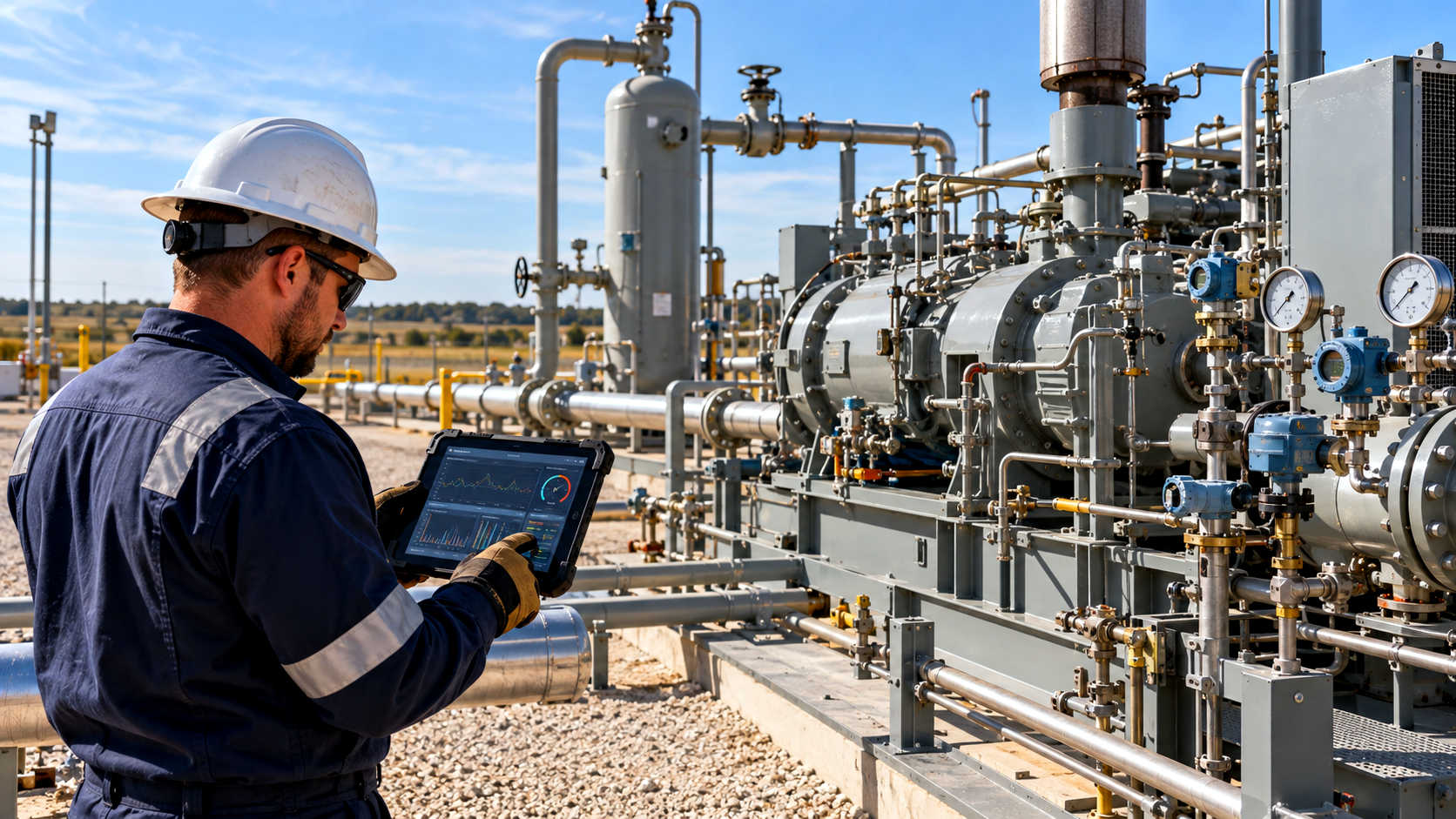
Natural gas compressors play a critical role in oil and gas production. From wellhead operations to gathering systems and pipeline transportation, these machines help maintain gas flow, manage pressure, and support consistent production. When a compressor unexpectedly fails, the consequences can include lost production, expensive repairs, and operational delays.
Predictive maintenance in oil and gas offers operators a more proactive approach to equipment reliability. By combining real-time monitoring, operating data, and maintenance planning, companies can identify developing problems before they result in unexpected shutdowns.
Advances in compressor monitoring technology are making it easier to evaluate equipment performance, identify unusual operating conditions, and make informed maintenance decisions.
For operators managing natural gas compression equipment, understanding how these technologies work can help improve reliability while controlling maintenance costs.
What Is Predictive Maintenance in Oil and Gas?
Predictive maintenance uses equipment condition data, operating trends, and analytical tools to estimate when maintenance may be needed. Rather than waiting for a failure or relying entirely on fixed service intervals, operators can use available information to identify potential problems before they become more serious.
In oil and gas operations, predictive maintenance may involve monitoring equipment such as:
- Natural gas compressors
- Pumps and electric motors
- Gas processing equipment
- Production and gathering systems
- Engines and other rotating machinery
Sensors and monitoring systems collect information about operating conditions, including temperature, vibration, pressure, and equipment performance. This information can be evaluated against historical operating patterns or established thresholds to identify changes that may indicate a developing problem.
For example, an increase in compressor discharge temperature could indicate changing operating conditions, a cooling problem, or another issue requiring investigation. Monitoring that temperature over time may help maintenance personnel recognize a developing trend before the equipment reaches an unsafe operating condition.
The goal is not to eliminate routine maintenance, but to make maintenance decisions more informed and timely.
Why Predictive Maintenance Matters for Natural Gas Compressors
Natural gas compressors frequently operate for extended periods under demanding conditions. Pressure changes, fluctuating gas volumes, temperature extremes, and mechanical wear can all affect compressor performance.
A compressor that operates inefficiently or experiences an unexpected shutdown can affect more than the equipment itself. Depending on the application, a failure may interrupt gas gathering, restrict production, or create additional pressure-related challenges.
A well-designed predictive maintenance strategy can help operators address several important concerns.
Reduce Unexpected Compressor Downtime
Unexpected equipment failures can interrupt production and create expensive service requirements.
By identifying unusual performance trends early, operators may have an opportunity to schedule inspections, repairs, or component replacement before a developing issue causes a shutdown.
This can be especially valuable at remote well sites, where equipment access, technician availability, and replacement parts may complicate emergency repairs.
When equipment must be taken offline for major maintenance or repairs, rental compression equipment may provide temporary capacity to help operators maintain gas flow while their existing compressor is serviced.
Improve Equipment Reliability and Service Life
Mechanical components experience wear throughout normal operation. However, unusual vibration, excessive temperatures, lubrication problems, or operation outside recommended conditions can accelerate deterioration.
Monitoring these conditions can help operators recognize problems that might otherwise go unnoticed between inspections.
When combined with appropriate maintenance procedures, early intervention may help prevent secondary damage and support longer equipment service life.
Improve Maintenance Planning and Cost Control
Emergency maintenance often creates additional costs through unplanned labor, expedited parts, equipment transportation, and production interruptions.
Predictive maintenance allows operators to prioritize service based on equipment condition and operational risk.
Instead of relying exclusively on calendar-based maintenance schedules, field teams can use monitoring data to identify which equipment requires closer attention.
Condition-Based Maintenance vs. Predictive Maintenance
Although the terms are sometimes used interchangeably, condition-based maintenance and predictive maintenance are not exactly the same.
Condition-based maintenance focuses on the equipment’s current condition. Maintenance actions are triggered when monitored measurements or inspection results indicate that attention is needed.
Predictive maintenance goes a step further by analyzing equipment condition and historical trends to estimate how a problem may develop or when maintenance may become necessary.
Both approaches can improve maintenance planning, but they use equipment information differently.
The U.S. Department of Energy’s maintenance best practices also emphasize the importance of combining different maintenance approaches to improve equipment reliability and operational efficiency.
Comparing Four Maintenance Approaches
| Maintenance Approach | How It Works | Compressor Example |
|---|---|---|
| Reactive maintenance | Repairs occur after equipment fails. | Replacing a component after a compressor shuts down unexpectedly. |
| Preventive maintenance | Service follows established time or operating-hour intervals. | Changing oil or inspecting components according to the manufacturer’s schedule. |
| Condition-based maintenance | Service is triggered by observed equipment conditions. | Investigating a compressor when vibration readings exceed established limits. |
| Predictive maintenance | Trends and analytical methods help estimate developing failures or maintenance needs. | Analyzing vibration and temperature trends to anticipate a potential mechanical problem. |
For many oilfield operators, the most practical strategy combines these approaches.
Routine inspections, scheduled servicing, and manufacturer-recommended maintenance remain essential. Condition monitoring and predictive analysis provide additional information that can help maintenance teams make better decisions.
How Compressor Condition Monitoring Works
Effective equipment condition monitoring begins with collecting meaningful operating data.
Natural gas compressors may be equipped with instrumentation and control systems that measure operating conditions and communicate information to local or remote monitoring platforms.
The measurements available depend on the compressor design, package configuration, and installed instrumentation.
Several operating parameters are particularly valuable.
Suction and Discharge Pressure
Suction and discharge pressures help operators evaluate compressor operating conditions.
Changes in these measurements may indicate fluctuating production volumes, downstream restrictions, control issues, or other changes affecting the compression process.
Monitoring pressure trends can help operators recognize when a compressor is operating outside its expected range.
Compressor Temperature
Temperature measurements can provide useful information about equipment performance.
Depending on the compressor design, operators may monitor discharge temperature, bearing temperatures, lubricant temperature, and cooling-system performance.
Unusual temperature increases can indicate operating changes or developing mechanical problems that warrant investigation.
Vibration Levels
Vibration monitoring can help identify certain mechanical problems in rotating equipment.
Depending on the equipment and measurement methods, changes in vibration patterns may indicate issues involving bearings, alignment, imbalance, or other mechanical conditions.
However, not every compressor package requires the same vibration monitoring arrangement. Instrumentation should be selected according to equipment design and operating requirements.
Lubrication System Performance
Lubrication is essential for many compressor components.
Monitoring oil pressure, lubricant temperature, and other relevant conditions can help identify potential lubrication problems before they contribute to equipment damage.
Oil analysis can provide additional information about contamination, lubricant degradation, and certain types of component wear.
Flow Rates and Operating Performance
Gas flow measurements, pressure relationships, and power consumption can help operators evaluate compressor performance.
Changes in these measurements do not necessarily indicate equipment failure. They may reflect changing production conditions or differences in gas composition.
For that reason, monitoring data should be evaluated within the context of the compressor’s operating requirements.
The Role of Predictive Maintenance Software in Oil and Gas
Modern predictive maintenance software helps organize, visualize, and analyze operating information collected from industrial equipment.
Instead of relying exclusively on individual instrument readings or manual logs, operators can use monitoring platforms to review equipment trends and identify changes across multiple assets.
Depending on the software and installed instrumentation, these systems may provide several capabilities.
Real-Time Equipment Monitoring
Monitoring platforms can display operating information from compressors and related production equipment.
This allows authorized personnel to review important performance indicators without requiring every measurement to be collected manually at the site.
Remote access can be especially useful for companies operating equipment across multiple production locations.
Automated Alerts and Notifications
Monitoring software can be configured to identify conditions that exceed established operating thresholds.
For example, a system may generate an alert when compressor discharge pressure, temperature, or another monitored parameter moves outside an acceptable range.
These alerts can help field personnel investigate potential problems before they escalate.
Monitoring alerts supplement, rather than replace, properly designed protective shutdown systems.
Historical Performance Analysis
Historical data allows maintenance personnel to compare current compressor operation with previous performance.
Gradual changes may be difficult to recognize during individual equipment inspections. Reviewing trends over several days or weeks can make those changes easier to identify.
Historical information can also help technicians evaluate recurring problems and assess the results of maintenance activities.
Artificial Intelligence and Predictive Analytics
Some advanced monitoring platforms use artificial intelligence, machine learning, or statistical models to analyze equipment data.
These technologies may help identify unusual patterns and estimate the likelihood of certain equipment problems.
However, the effectiveness of predictive analytics depends on several factors, including sensor accuracy, data quality, equipment operating conditions, and the availability of useful historical information.
AI-based recommendations should be evaluated alongside technical expertise, equipment specifications, and established maintenance procedures.
Industrial Predictive Maintenance in Remote Oilfield Operations
One of the challenges of industrial predictive maintenance is applying monitoring technology in demanding field environments.
Oil and gas equipment may operate at remote locations with limited communications infrastructure, extreme temperatures, changing production requirements, and restricted access to technical personnel.
These conditions can influence how monitoring systems are selected and installed.
For smaller operators, a practical monitoring strategy does not necessarily require an extensive network of sensors or a sophisticated AI platform.
A simpler approach may involve tracking essential operating parameters, establishing appropriate alarm thresholds, and reviewing trends during routine maintenance.
For larger operations, centralized monitoring can help maintenance managers oversee multiple compressor packages and identify equipment requiring attention.
Regardless of the size of the operation, monitoring technology should provide information that supports meaningful maintenance decisions.
How Predictive Maintenance Supports Safety and Operational Compliance
Natural gas compression equipment operates under conditions that require careful attention to equipment integrity and safe operation.
Pressure abnormalities, overheating, gas leaks, and mechanical failures may create operational or safety concerns.
Monitoring systems can provide additional visibility into equipment conditions and help operators respond to potential problems.
Depending on the instrumentation installed, monitoring capabilities may include:
- High-temperature and abnormal-pressure notifications
- Monitoring of compressor operating status
- Historical records of alarms and operating conditions
- Integration with appropriate gas detection systems
- Remote visibility into equipment shutdowns and operating changes
Recorded equipment data may also support maintenance documentation, operational reviews, and certain compliance-related activities.
However, monitoring software alone does not establish regulatory compliance. Operators must continue to follow applicable requirements, inspection procedures, and equipment safety standards.
Choosing the Right Compressor Monitoring Strategy
Not every natural gas compressor requires the same level of monitoring.
The appropriate strategy depends on equipment design, operating conditions, production requirements, and the consequences of unexpected downtime.
Before selecting a monitoring platform or predictive maintenance system, operators should consider several questions.
What Equipment Conditions Need to Be Monitored?
The first step is identifying which measurements provide useful information about the compressor’s operation.
Temperature, vibration, pressure, and lubrication measurements may all be relevant, but their importance varies by equipment type.
Is the Existing Equipment Compatible?
Some compressor packages already include instrumentation, programmable logic controllers (PLCs), or other control equipment that can support additional monitoring.
Operators should determine whether existing systems can communicate with the proposed platform or whether additional instrumentation is required.
Can the System Integrate With Existing Operations?
Where supervisory control and data acquisition (SCADA) systems are already in use, integration capabilities may influence platform selection.
Other considerations include remote communications, data storage, mobile access, cybersecurity, and software support.
Will the Information Improve Maintenance Decisions?
Collecting more data does not automatically improve reliability.
A monitoring system should help operators recognize meaningful equipment changes, prioritize maintenance, and respond appropriately to developing problems.
The most useful solution is one that matches the equipment’s operating requirements and the maintenance team’s ability to act on the information.
Predictive Maintenance Works Best With Proper Compressor Selection and Field Service
Monitoring technology provides valuable information, but compressor reliability begins with proper equipment selection, installation, and maintenance.
A compressor that is poorly matched to an application may experience operating challenges that monitoring software alone cannot correct.
Factors such as suction pressure, discharge pressure, gas volume, gas composition, available power, and changing production requirements should be considered when evaluating small natural gas compressors and other compression equipment.
Likewise, routine maintenance and qualified natural gas compressor field services remain essential for reliable operation. Experienced technicians can help identify equipment problems, perform necessary repairs, and support dependable compressor performance.
Midwest Compressor Systems provides natural gas compressor packages for sale, lease, and rent, along with field services to support equipment operating in demanding oil and gas environments.
By combining appropriately selected compression equipment with effective maintenance practices and suitable monitoring capabilities, operators can take a more proactive approach to compressor reliability.
The Future of Predictive Maintenance in Oil and Gas
Monitoring technology continues to create new opportunities for improving equipment reliability across the oil and gas industry.
As data collection, remote communications, and analytical tools advance, operators have more options for understanding compressor performance and identifying developing equipment problems.
However, successful predictive maintenance is not simply about adopting the newest software.
It requires accurate measurements, appropriate maintenance procedures, reliable equipment, and personnel who understand how to interpret operating information.
For natural gas compression applications, the most effective approach combines modern monitoring capabilities with established equipment knowledge and practical field experience.
Predictive maintenance in oil and gas is ultimately about making better maintenance decisions, reducing avoidable interruptions, and keeping critical equipment operating reliably.
Keep Your Natural Gas Compression Equipment Performing Reliably
Reliable compression is essential to maintaining consistent oil and gas operations.
Whether you are evaluating new compressor equipment, planning an equipment upgrade, or looking for dependable field support, Midwest Compressor Systems can help you assess your compression requirements.
With decades of experience in natural gas compression, Midwest Compressor provides equipment solutions and field services for demanding oilfield applications.
Contact Midwest Compressor Systems to discuss your natural gas compression needs and explore equipment options suited to your operation.