

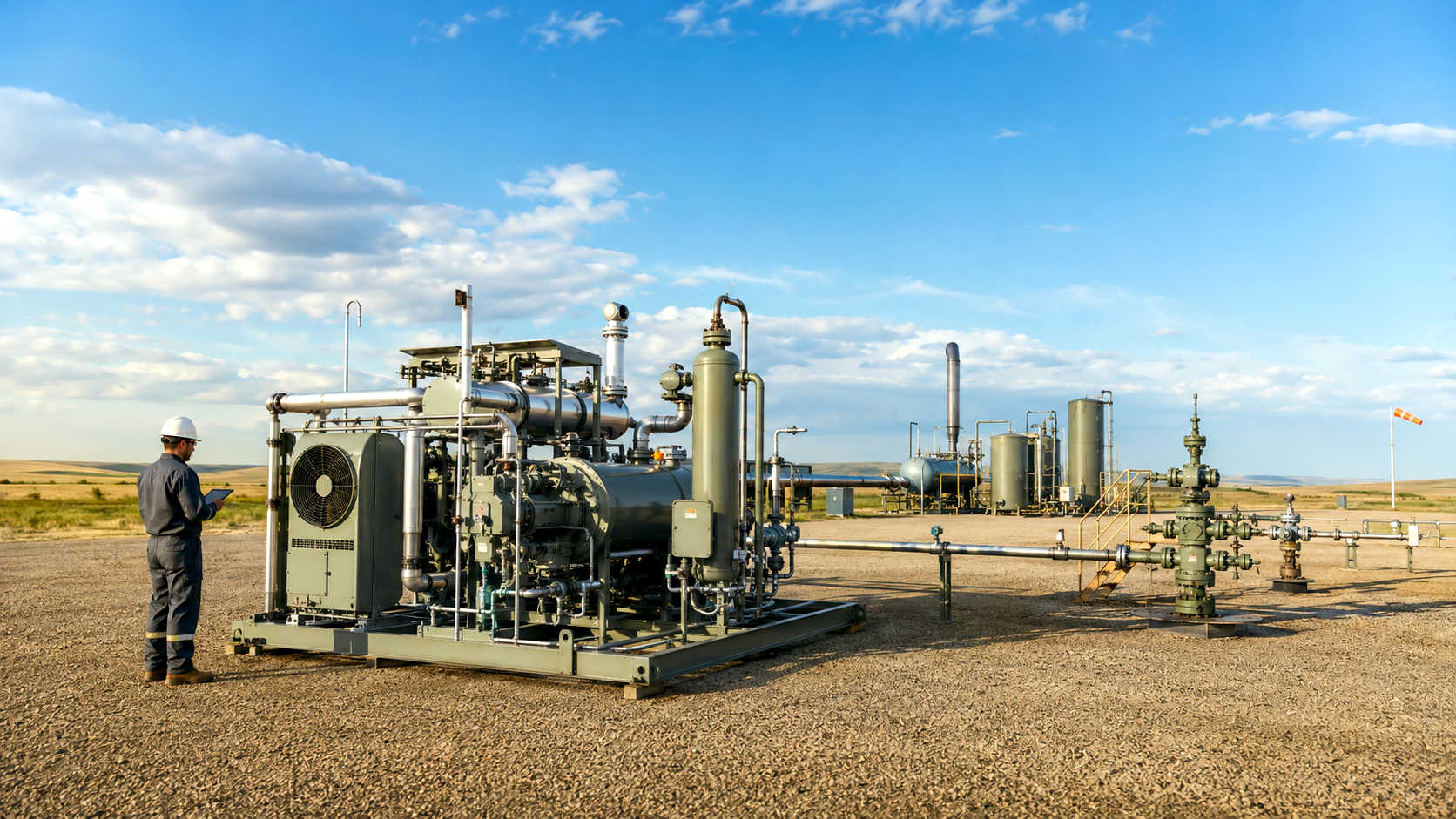
Large compressor packages receive much of the attention in the oil and gas industry, but bigger equipment is not automatically the better investment.
For many well sites, tank batteries, gathering systems, and temporary production projects, a small natural gas compressor can provide the pressure support an operator needs without the expense, footprint, or complexity of a larger installation.
Units under 450 horsepower can be particularly useful when production volumes do not justify oversized equipment. They may support declining wells, recover gas from low-pressure sources, overcome gathering-system backpressure, assist gas lift operations, or provide temporary compression while operating conditions are evaluated.
The key is not simply choosing a smaller compressor. It is choosing a properly sized compression package that matches the gas volume, suction pressure, discharge pressure, gas composition, site conditions, and production objective.
Quick Answer: When Does a Small Natural Gas Compressor Make Sense?
A small natural gas compressor may be a good fit when an operator needs to:
- Increase pressure from a low-pressure well or gas source
- Overcome gathering-line or sales-line backpressure
- Recover tank vapors or flash gas
- Support a small-volume gas lift application
- Reduce routine venting or flaring by moving recoverable gas
- Test production before installing permanent infrastructure
- Add temporary compression during changing field conditions
- Support marginal, mature, or declining wells
- Avoid paying for more horsepower than the application requires
A compression provider should review the complete operating data before recommending a unit. Horsepower is only one part of compressor selection.
What Is Considered a Small Natural Gas Compressor?
In this context, a small natural gas compressor is generally a compression package rated below approximately 450 horsepower.
That category can include a wide range of equipment. Some packages are compact and portable, while others are engineered for longer-term installation. Depending on the application, the package may use a reciprocating compressor driven by a natural gas engine, an electric motor, or another suitable power source.
A smaller horsepower rating does not necessarily mean the unit serves an unimportant role. These compressors can address highly specific production constraints where a larger system would be inefficient, uneconomical, or difficult to deploy.
The most important question is not, “How large is the compressor?”
It is, “Can this compressor safely and reliably meet the required flow and pressure conditions?”
Common Applications for Small Natural Gas Compressors
Wellhead Compression
As a gas well matures, reservoir or casing pressure may decline while gathering-line pressure remains relatively constant. That pressure difference can restrict flow and reduce production even when recoverable gas remains in the formation.
A properly selected small wellhead compressor can lower the effective pressure the well must produce against and raise the gas to the pressure required by the gathering system.
This does not create additional gas in the reservoir. Instead, it may help remove a surface pressure restriction that is preventing the well from flowing efficiently.
Wellhead compression may be especially valuable for:
- Mature natural gas wells
- Low-pressure wells
- Marginal or stripper wells
- Wells affected by rising gathering-system pressure
- Locations where several low-volume wells feed a common line
Tank Vapor and Flash Gas Recovery
Oil and condensate storage operations can release hydrocarbon vapors as pressure and temperature conditions change. A small natural gas compressor may be incorporated into a vapor recovery system to collect this gas and route it to a sales line, fuel system, processing unit, or another approved destination.
The U.S. EPA’s guidance on vapor recovery units explains how these systems capture methane from storage tanks and other low-pressure vented gas sources across oil and gas operations.
The commercial value depends on the recoverable gas volume, gas composition, available outlet, installation cost, and applicable operating requirements.
When conditions are suitable, vapor recovery can help an operator:
- Capture gas that may otherwise be lost
- Improve gas utilization
- Reduce routine venting
- Support emissions-management objectives
- Recover potential product value
Similar compression-based approaches can also be used in broader gas flaring solutions when recoverable gas lacks sufficient pressure to enter a gathering, fuel, processing, or utilization system. The commercial feasibility depends on gas volume, composition, available outlets, operating requirements, and project economics.
The compressor must be designed for the expected inlet conditions and gas composition. Tank vapor service should not be treated as interchangeable with ordinary wellhead service.
Gas Lift Support
Gas lift systems require gas at sufficient pressure to inject into the well and reduce the hydrostatic pressure of the produced fluid column.
For lower-volume or isolated applications, a smaller compressor may provide the needed injection pressure without requiring a large centralized system.
When evaluating a compressor for gas lift, operators should consider injection pressure, required gas volume, available suction gas, expected production response, and the operating range of the well.
Gathering and Booster Compression
A small natural gas compressor can also increase gas pressure between a low-pressure source and a higher-pressure gathering system.
This application may be useful when:
- A remote well cannot consistently enter the gathering line
- Several low-volume wells need localized pressure support
- A production area has uneven pressure conditions
- Permanent centralized compression is not yet justified
- An operator needs a temporary solution during system changes
Temporary and Early-Production Compression
Production conditions can change significantly during the early life of a well or development area. Installing a permanent compressor before the operating range is understood can lead to oversizing, undersizing, or unnecessary capital expense.
A portable or rental compressor gives operators an opportunity to gather field data and determine whether compression produces an acceptable operational and financial result.
Temporary compression may support:
- New-zone testing
- Early production facilities
- Short-term pressure constraints
- Pipeline maintenance
- Seasonal operating changes
- Production optimization trials
- Emergency or backup service
Midwest Compressor Systems offers natural gas compressor rental options for operators that need flexible equipment during testing, early production, temporary pressure constraints, or changing field conditions. Available equipment includes small screw compressor packages, liquid-ring packages, gas-driven packages, and trailer-mounted test units, with options for rental, lease, or purchase.
Small Compressor Versus Larger Compressor
| Evaluation Factor | Small Natural Gas Compressor | Larger Compressor Package |
|---|---|---|
| Typical Application | Individual wells, tank batteries, localized gathering, and temporary projects | Centralized gathering, processing, pipeline, or high-volume service |
| Horsepower | Commonly under 450 HP | Often above 450 HP |
| Site Footprint | Generally smaller | Generally larger |
| Initial Investment | Often lower, depending on package design | Usually higher |
| Installation Complexity | May be simpler for suitable applications | Often requires more extensive infrastructure |
| Portability | Frequently available in skid-mounted or transportable configurations | Typically less mobile |
| Flow Capacity | Best suited to low or moderate gas volumes | Better suited to higher gas volumes |
| Operational Flexibility | Can be redeployed as field needs change | Often intended for longer-term fixed service |
| Risk of Oversizing | Lower when correctly matched to a small application | Greater if installed on a low-volume source |
| Best Purchasing Approach | Rental, lease, or purchase depending on project certainty | Usually supported by longer-term planning and stable operating data |
Neither option is universally better. The correct choice depends on the required duty, expected operating range, project duration, economics, and reliability requirements.
Benefits of Properly Sized Small Compression
Lower Capital Exposure
Operators may be able to add pressure support without committing to the acquisition and infrastructure costs associated with a larger compressor package.
This can be particularly important for marginal wells, uncertain projects, or locations where the production response has not yet been proven.
Reduced Risk of Oversizing
Oversized compression equipment can create problems of its own. A compressor operating far below its intended range may cycle excessively, run inefficiently, experience control problems, or require unnecessary recycling.
Correct sizing gives the package a better opportunity to operate within an appropriate range as field conditions change.
Smaller Physical Footprint
Space may be limited at older well sites, tank batteries, or facilities that were not originally designed for additional equipment.
Compact packages can be easier to position when the site has limited usable space, although access, ventilation, separation distances, maintenance clearance, foundations, and other installation requirements must still be considered.
Easier Redeployment
Many smaller compressors are installed on skids or in configurations that can be moved between locations.
This can help operators respond to changing production priorities. A unit may initially support a low-pressure well, move to a temporary gathering application, and later be reassigned to another qualified location.
Redeployment should always follow a new application review. A compressor selected for one pressure and gas-composition range may not be suitable for another.
Lower Operating Costs in the Right Application
A smaller compressor may consume less fuel and require fewer site modifications than a larger package when both are compared within an appropriately sized application.
However, operators should evaluate total lifecycle cost rather than horsepower alone. Fuel consumption, maintenance requirements, downtime, rental expense, transportation, installation, and production improvement all affect the actual economics. Access to dependable natural gas compressor field services can also help protect equipment availability by supporting ongoing maintenance and addressing operating problems before they lead to prolonged downtime.
What Information Is Needed to Size a Small Natural Gas Compressor?
Before requesting a quote, operators should gather as much of the following information as possible:
- Current and expected gas volume
- Minimum, normal, and maximum suction pressure
- Required discharge pressure
- Suction temperature
- Gas composition or gas analysis
- Specific gravity
- Expected liquids or contaminants
- Available fuel gas
- Available electrical service
- Site elevation
- Ambient temperature range
- Current gathering-line pressure
- Expected changes in production
- Required runtime and availability
- Project duration
- Installation location and access limitations
- Applicable permitting or emissions requirements
Incomplete or overly optimistic field data can lead to poor equipment selection. A compressor should be evaluated across the anticipated operating envelope, not just one ideal operating point.
Should You Rent or Buy a Small Natural Gas Compressor?
The right acquisition method depends largely on how certain the operator is about the application.
| Operating Situation | Rental May Be Preferable | Purchasing May Be Preferable |
|---|---|---|
| Project Duration | Short-term or uncertain | Long-term and predictable |
| Production Response | Still being tested | Already demonstrated |
| Operating Conditions | Expected to change | Relatively stable |
| Capital Availability | Capital preservation is important | Capital has been allocated |
| Maintenance Resources | Outside service is preferred | Internal maintenance capabilities are available |
| Deployment Needs | Unit may move among locations | Unit will remain at one location |
| Equipment Utilization | Intermittent or project-based | Consistently high utilization |
| Ownership Objective | Flexibility and reduced commitment | Long-term asset control |
Operators who are still comparing acquisition options can review this detailed guide to natural gas compressor rentals versus buying. It explains how capital costs, lifecycle expenses, field performance, compliance requirements, maintenance responsibilities, and project duration can affect the final decision.
In general, renting can reduce the risk of committing to equipment before field performance is understood, while purchasing may provide stronger long-term economics when operating conditions are stable and utilization remains consistently high.
Operators should compare the total cost of each option—not merely the monthly rental rate or purchase price.
Questions to Ask a Small Natural Gas Compressor Provider
Before selecting a compressor company, ask:
- What operating data do you need to size the package?
- Can the proposed unit handle the minimum and maximum expected conditions?
- What turndown or capacity-control options are available?
- Is the package designed for the specific gas composition?
- What happens if suction or discharge pressure changes?
- Is the unit suitable for continuous or intermittent operation?
- What site preparation is required?
- Who is responsible for installation and startup?
- What maintenance support is included?
- How quickly are replacement parts or field technicians available?
- Can the unit be exchanged if the application changes?
- What monitoring, shutdown, or remote-control features are available?
- What fuel or electrical requirements apply?
- What information will be provided to support permitting and compliance review?
- Are rental, lease, and purchase options available?
A reputable provider should be willing to explain why a particular package fits the application and how it will be supported after installation. Midwest Compressor Systems provides small-horsepower compressor support through a technical service group that specializes in smaller compression applications. A recommendation based only on horsepower is not enough.
Signs That a Small Compressor May Not Be the Right Choice
A smaller unit may not be appropriate when:
- The expected flow rate exceeds the package capacity
- The compression ratio is outside the recommended operating range
- Gas composition creates material or safety concerns
- Significant liquids cannot be adequately managed
- The application requires more stages than the package provides
- Production is expected to increase rapidly
- Redundancy or extremely high availability is required
- Site conditions prevent safe installation or maintenance access
- The discharge requirement is incompatible with the proposed equipment
- The package would need to operate continuously at or beyond its rated limit
Selecting an undersized compressor can be just as costly as installing an oversized one. The goal is to match the package to real field conditions while allowing an appropriate operating margin.
Frequently Asked Questions About Small Natural Gas Compressors
What is a small natural gas compressor?
A small natural gas compressor is a compact compression package designed to increase the pressure of natural gas at relatively low or moderate flow rates. In oilfield applications, the term often refers to equipment below approximately 450 horsepower, although the exact definition can vary by provider and application.
What is a small natural gas compressor used for?
Common uses include wellhead compression, tank vapor recovery, flash gas compression, gas lift, localized gathering, fuel-gas boosting, temporary production support, and low-pressure gas transfer.
Can a small compressor increase well production?
It may increase production when excessive surface pressure or gathering-line backpressure is restricting flow. The result depends on reservoir conditions, well performance, line pressure, equipment sizing, and other operating factors. A field evaluation is required to estimate the likely benefit.
How much gas can a small natural gas compressor handle?
Capacity varies widely. Horsepower alone does not determine flow. Suction pressure, discharge pressure, compression ratio, gas composition, temperature, compressor configuration, speed, and available stages all affect capacity.
Can small compressors be used for vapor recovery?
Yes, when the package is specifically designed and configured for the vapor composition, pressure, temperature, and expected liquid conditions. Vapor-recovery applications require careful engineering and should not be treated as standard wellhead compression.
Are small natural gas compressors portable?
Many are skid-mounted or designed for relatively easy transportation. Portability depends on the complete package, including the driver, cooler, scrubber, piping, controls, enclosure, and site requirements.
Is renting a natural gas compressor better than buying one?
Renting may be better for temporary, uncertain, or changing applications. Purchasing may make more financial sense for stable, long-term service with consistently high utilization. Operators should compare total lifecycle costs and operational responsibilities.
What data are needed to receive a compressor quote?
At minimum, the provider will generally need expected gas volume, suction pressure, required discharge pressure, temperature, gas composition, site elevation, ambient conditions, and the intended application. Better data usually produces a more reliable equipment recommendation.
How do I know what horsepower compressor I need?
Horsepower should be calculated from the required compression duty. It should not be selected independently. A compression provider should model the operating conditions and recommend an appropriate compressor, driver, staging arrangement, and control strategy.
Can a small compressor help reduce flaring?
It may help when usable gas is being flared because it lacks sufficient pressure to reach a gathering, processing, fuel, or utilization system. The operator must still confirm gas quality, outlet capacity, project economics, safety requirements, and regulatory obligations.
Is a Small Natural Gas Compressor Right for Your Operation?
A small natural gas compressor can be a practical commercial solution when an operation needs targeted pressure support without the cost and infrastructure of a larger package.
The strongest applications are not determined by horsepower alone. They are identified by reviewing the production objective, gas volume, suction pressure, discharge requirement, gas composition, project duration, site limitations, and expected economic return.
For operators managing mature wells, low-pressure gas, tank vapors, temporary production constraints, or localized gathering challenges, a properly sized unit under 450 horsepower may deliver the right balance of performance, flexibility, and cost control.
Midwest Compressor Systems works with operators to evaluate field conditions and identify compression equipment suited to the application. Rental and equipment options can be considered based on operating requirements, project duration, and production goals.
Contact Midwest Compressor Systems to discuss your pressures, gas volume, site conditions, and compression objective. A field-specific review can help determine whether a small natural gas compressor is the right fit—and what size and configuration the application actually requires. Call Midwest Compressor today. Call 806-669-3247 or 859-643-9378 if you’re in the Midwest.