

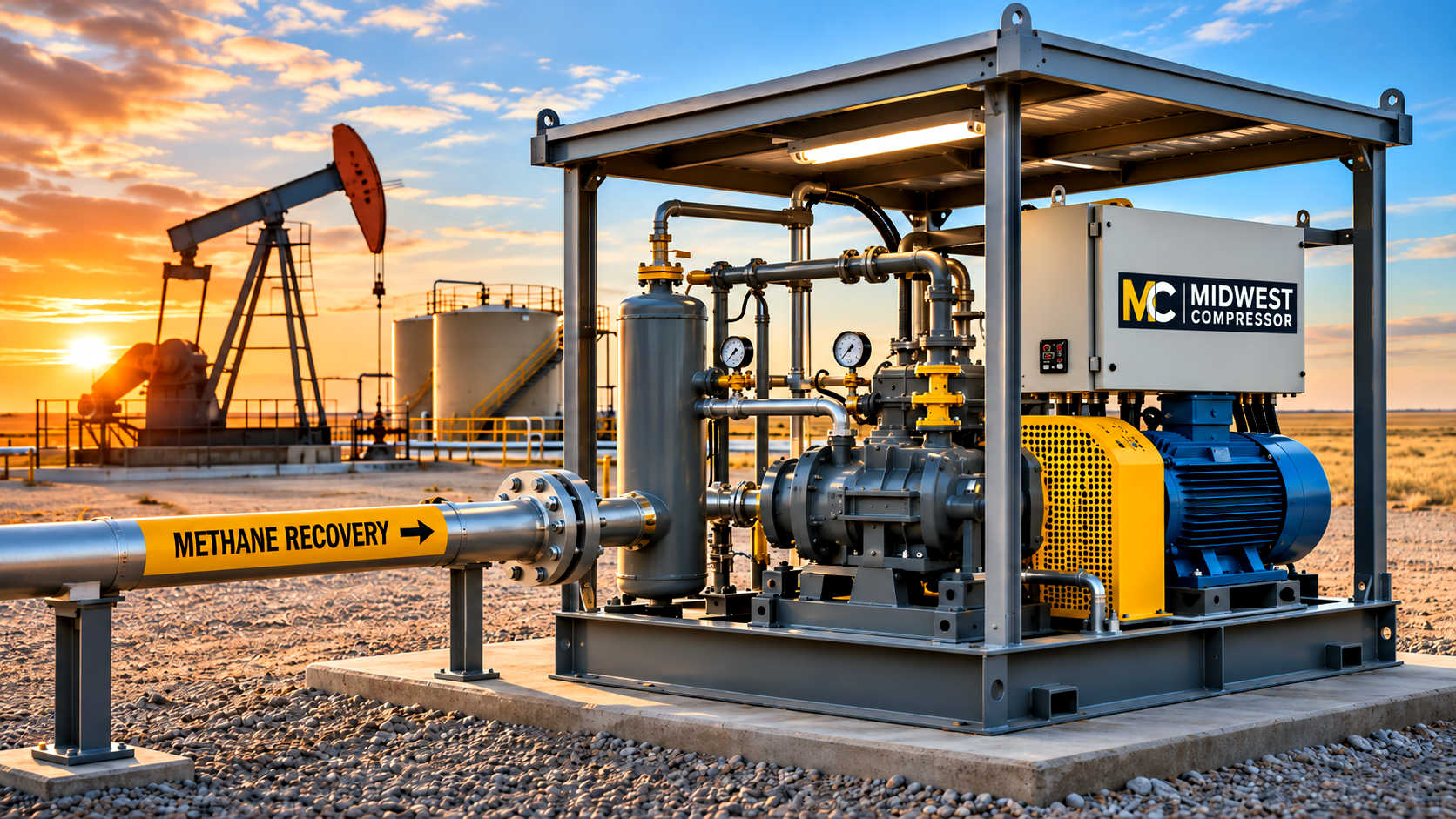
In oil and gas production, large compressor systems often receive the most attention. However, not every gas-handling challenge requires hundreds of horsepower or a major infrastructure investment. For operators managing low-volume gas streams, declining well pressures, or recoverable methane emissions, a small methane gas compressor can offer a practical alternative.
Smaller compression packages can help move methane-rich gas from low-pressure sources into gathering lines, fuel systems, or recovery infrastructure. When properly sized for the application, these units can support production, improve gas utilization, and help operators capture value from gas that might otherwise be lost.
The key is matching the equipment to actual field conditions rather than installing more compression capacity than the operation requires.
What Is a Small Methane Gas Compressor?
A small methane gas compressor is a compression unit designed to increase the pressure of methane or methane-rich gas for transportation, recovery, processing, or reuse.
In oilfield applications, these compressors generally handle natural gas streams containing methane as the primary component, along with varying amounts of heavier hydrocarbons and other gases.
Small horsepower applications often involve equipment rated below approximately 100 horsepower, although there is no universal horsepower cutoff. The appropriate unit size depends on the operating conditions rather than a specific horsepower classification.
Unlike general-purpose compressed-air equipment, a compressor handling methane-rich gas must be designed for the gas composition, pressure conditions, and applicable safety requirements.
These units may be configured as skid-mounted packages or other compact systems, using electric motors or gas engine drives depending on site requirements.
Quick Answer: When Does a Small Methane Compressor Make Sense?
A small methane gas compressor may be a practical solution when an operator needs to:
- Recover methane-rich gas from low-pressure production sources
- Support vapor recovery at tank batteries and production facilities
- Increase gas pressure for gathering or onsite utilization
- Handle relatively small or fluctuating gas volumes
- Reduce gas losses from suitable recovery applications
- Provide localized compression without installing a larger central system
- Evaluate recovery opportunities before committing to permanent equipment
The suitability of any compressor depends on available gas volume, suction pressure, required discharge pressure, gas composition, and the intended destination of the compressed gas.
For a broader discussion of compressor sizes and applications, see our guide to small natural gas compressors.
Where Small Methane Gas Compressors Deliver the Most Value
Small horsepower compression equipment can be especially valuable where conventional large-scale compression would be difficult to justify economically.
Low-Volume Gas Recovery at Remote Wells
Remote oil and gas wells frequently operate under conditions that make centralized compression impractical.
A well may produce a relatively small quantity of gas, yet that gas may still have commercial value if sufficient pressure can be developed to move it into an available gathering or utilization system.
A small methane compressor can provide localized pressure support without requiring a large compressor installation.
Depending on the site, potential applications include:
- Small-volume associated gas recovery
- Low-pressure gas gathering
- Remote production facilities
- Temporary gas-handling projects
- Small satellite production sites
For operators managing multiple geographically dispersed wells, smaller packages may also provide flexibility when compression requirements change.
Mature and Declining-Pressure Wells
As a natural gas well matures, its available flowing pressure may decline while gathering-system pressure remains relatively constant.
Eventually, the pressure difference can restrict gas movement even when recoverable gas remains in the reservoir.
Properly selected compression equipment can help overcome this surface pressure limitation by increasing gas pressure to the level required by the receiving system.
At lower-volume sites, a small compressor may be more practical than installing equipment designed for substantially higher throughput.
However, an operator should evaluate the expected production response, gas composition, pressure ratio, and operating costs before determining whether additional compression is economically justified.
Gathering-System Pressure Boosting
Not every gathering application requires a large centralized compressor station.
Smaller gas streams may benefit from localized pressure boosting, particularly where line pressure is restricting movement into a downstream gathering system.
A small methane gas compressor may provide the additional discharge pressure needed to move gas toward its intended destination.
The compressor must be selected for both current conditions and reasonably anticipated changes in gas volume and pressure. Installing too much capacity can create unnecessary expense, while insufficient capacity may prevent the system from achieving its operating objectives.
Methane Recovery and Vapor Capture Applications
One of the most important opportunities for smaller methane compression equipment involves recovering hydrocarbon vapors from oil and gas production operations.
Crude oil and condensate storage tanks can release methane-rich vapors as liquids enter storage, pressure changes, or lighter hydrocarbons separate from the stored product.
Without an appropriate recovery system, some of these vapors may be vented or otherwise directed to an emissions-control system.
A vapor recovery unit (VRU) can capture suitable gas streams and compress them for beneficial use or further processing.
According to the U.S. Environmental Protection Agency’s guidance on vapor recovery units, these systems can recover methane and other hydrocarbons from storage tanks and certain additional low-pressure gas sources.
How Compression Supports Vapor Recovery
A typical compressor-based vapor recovery process includes several coordinated steps:
- Gas collection: Low-pressure hydrocarbon vapors are collected from compatible tanks or other designated sources.
- Liquid separation: A suction scrubber or other separation equipment removes entrained or condensed liquids before compression.
- Gas compression: An appropriately designed compressor increases the gas pressure to meet downstream requirements.
- Gas transfer: Recovered gas is directed to an approved sales line, production system, fuel supply, or other suitable destination.
- System monitoring: Controls and protective devices help maintain safe operating conditions as gas flow and pressure change.
The compressor is only one component of the overall recovery system. Proper design must also account for vapor collection, liquid handling, tank pressure protection, automatic shutdowns, and applicable operating requirements.
Evaluating the Value of Recovered Methane
Methane recovery is more than an emissions-management consideration. It may also represent an opportunity to retain or monetize gas that would otherwise be lost.
Depending on the composition of the recovered stream, valuable natural gas liquids and other hydrocarbons may accompany the methane.
For operators, the potential advantages include:
- Recovering usable hydrocarbons
- Reducing losses from suitable low-pressure gas sources
- Supporting emissions-reduction objectives
- Improving utilization of existing production resources
- Creating potential revenue where a commercial outlet exists
However, vapor recovery is not automatically profitable at every location.
The available gas volume, composition, equipment costs, power requirements, transportation infrastructure, and value of the recovered product all influence project economics.
An effective evaluation begins by estimating how much gas is available for recovery and determining whether a suitable destination exists.
Benefits of Small Methane Compression Equipment
Smaller compression packages provide several practical advantages when their capacity and operating characteristics match the application.
Lower Equipment and Infrastructure Requirements
A smaller compression package may require less installation space and supporting infrastructure than a substantially larger system.
This can be particularly useful at remote production sites or existing facilities with limited available space.
However, total installation costs still depend on foundations, piping, electrical requirements, gas treatment, and other site-specific needs.
Flexible Deployment
Skid-mounted and transportable compressor configurations can offer flexibility when production conditions change.
For example, operators may need temporary compression while evaluating gas recovery potential or transitioning between production phases.
Depending on the equipment configuration, a smaller unit may be relocated or reassigned when its original application no longer requires the same capacity.
Better Capacity Matching
Oversizing a compressor can create unnecessary capital and operating expenses.
A properly selected smaller package allows operators to match compression capacity more closely to the available gas stream.
This becomes particularly important when gas volumes are limited or expected to decline.
Potential Operating Cost Advantages
Smaller compressors generally require less installed power than significantly larger units, but horsepower alone does not determine operating efficiency.
Actual costs depend on compression ratio, gas flow, equipment design, duty cycle, fuel or electricity costs, and maintenance requirements.
The most economical solution is the one that reliably delivers the required performance at an acceptable total operating cost.
How to Select a Small Methane Gas Compressor
Selecting compression equipment requires more than identifying a desired horsepower rating.
Operators should evaluate the complete gas-handling application before choosing a compressor package.
1. Available Gas Volume
Determine the expected gas flow under normal operating conditions, including minimum and maximum anticipated volumes.
For vapor recovery applications, average flow may not adequately represent short periods of elevated vapor generation.
2. Suction Pressure
The pressure available at the compressor inlet directly affects equipment selection.
Very low suction pressures can create additional technical requirements, particularly in vapor recovery applications where the compressor must handle gas without creating unacceptable vacuum conditions upstream.
3. Required Discharge Pressure
Identify the pressure needed to deliver the gas into the intended receiving system.
Higher pressure ratios may require additional horsepower, different compressor arrangements, or multiple compression stages.
4. Gas Composition
Produced gas is not always dry, pipeline-quality methane.
Depending on the source, it may contain heavier hydrocarbons, water vapor, carbon dioxide, hydrogen sulfide, or other constituents.
Gas analysis helps determine appropriate materials, sealing arrangements, separation equipment, and operating safeguards.
5. Liquid Handling Requirements
Wet gas streams require particular attention.
Entrained liquids or condensate can damage compression equipment that is not designed to tolerate them. Proper upstream separation and liquid management are essential to reliable operation.
6. Available Power
Electric-drive compressors may be suitable for facilities with reliable electrical infrastructure.
Gas engine-driven packages may offer an alternative at remote locations where grid power is unavailable or impractical.
The most appropriate configuration depends on power availability, fuel supply, maintenance considerations, and site requirements.
7. Expected Operating Life and Project Economics
Operators should consider how long the compression equipment will be needed and whether gas volumes are expected to remain stable.
A short-term recovery project may favor rental equipment, while a long-term application with predictable operating conditions may support purchasing a dedicated compressor package.
The objective is to select a system that balances equipment investment, operating costs, reliability, and the potential value of recovered gas.
Small Methane Compressor Packages from Midwest Compressor Systems
Midwest Compressor Systems provides natural gas compression equipment for a range of oilfield applications, including wellhead compression, vapor recovery, and gas-handling operations.
Its published equipment offerings include smaller screw compressor packages with electric or gas engine drive options.
Examples include:
| Compressor Package | Published Horsepower Range | Drive Options |
|---|---|---|
| MC-8 | 15–25 HP | Electric or gas engine |
| MC-10 | 50–70 HP | Electric or gas engine |
These packages demonstrate the availability of smaller horsepower compression equipment. However, suitability for a particular methane recovery or vapor-handling application must be evaluated based on the gas composition, operating pressures, flow requirements, and necessary supporting equipment.
Midwest also offers additional compressor configurations, packaging components, and equipment options for more specialized applications.
For operators evaluating a project, the starting point should be the actual field data rather than a preferred compressor model.
Renting, Leasing, or Purchasing a Small Methane Compressor
Choosing how to acquire compression equipment can be just as important as selecting the equipment itself.
When Rental or Leasing May Make Sense
Rental or leasing arrangements may be attractive when:
- The project has an uncertain operating duration
- Gas recovery potential has not yet been fully established
- Production conditions are expected to change
- Temporary compression is needed
- The operator wants to limit an initial equipment purchase commitment
Rental equipment can also help operators evaluate performance before making a longer-term investment.
When Purchasing May Be the Better Choice
Purchasing may make sense when the project has predictable operating requirements, sustained gas availability, and a sufficiently long service life.
Ownership can provide greater control over equipment configuration and long-term operating decisions, although the operator must also account for maintenance, repairs, and eventual replacement.
Midwest Compressor Systems offers natural gas compressor rental, leasing, and sales options, allowing operators to explore equipment arrangements suited to their operational and financial requirements.
Reliable performance also depends on appropriate maintenance and technical support. Midwest provides compressor field services to help support equipment operation.
Frequently Asked Questions About Small Methane Gas Compressors
What is a small methane gas compressor used for?
A small methane gas compressor increases the pressure of methane or methane-rich natural gas so it can be transported, recovered, or utilized. Common oilfield applications include low-volume gas recovery, localized pressure boosting, and suitable vapor recovery operations.
Can a small methane compressor recover gas that would otherwise be vented?
Yes, when incorporated into an appropriately designed recovery system. The compressor can raise the pressure of captured gas so it can move to a suitable destination. Recovery feasibility depends on gas composition, volume, pressure conditions, and available infrastructure.
How much horsepower does a small methane compressor need?
There is no single horsepower requirement. Smaller applications may use equipment below 100 HP, but the necessary power depends on gas flow, suction and discharge pressures, gas composition, and compressor efficiency. Proper sizing requires an evaluation of actual operating conditions.
Is a methane compressor the same as a natural gas compressor?
Methane is the primary component of most natural gas, so equipment used for methane-rich gas is often described as natural gas compression equipment. However, compressors must be selected for the complete gas composition and operating requirements rather than assuming all methane-containing streams behave identically.
Can I rent a small methane gas compressor?
Small natural gas compressor packages are available for rental or leasing through providers such as Midwest Compressor Systems. Whether a particular package can serve a methane recovery application depends on the required gas-handling specifications and equipment configuration.
Finding the Right Methane Compression Solution for Your Operation
Recoverable methane does not always require a large compression system to become a useful resource.
For operators managing low-volume gas streams, remote production facilities, or suitable vapor recovery opportunities, a small methane gas compressor may provide the pressure support needed to move gas into a productive application.
The best results begin with a clear understanding of the available gas volume, operating pressures, composition, and intended destination.
Midwest Compressor Systems works with oil and gas operators to evaluate compression requirements and identify equipment options suited to their applications.
Considering a small methane compression project? Hit the contact button below to fill out our web form or call 806-669-3427 to discuss your gas-handling requirements, available compressor packages, and rental or purchase options.